ISC2 CISSP® Training Boot Camp

Take your career to the next level by earning one of the most in-demand cybersecurity certifications. CISSP training provides a proven method for mastering the broad range of knowledge required to become a Certified Information Systems Security Professional.

Description

Overview

Earning your CISSP requires a broad range of cybersecurity skills, from developing security policies to managing risk to understanding technical security controls. This approach to CISSP training provides the tools you need to master this knowledge. You’ll leave this training with the necessary skills and best practices to effectively create and execute enterprise-wide information security strategies — and pass your CISSP exam with flying colors the first time you take it.

The hands-on cybersecurity training platform that moves as fast as you do

Boot camps are engineered to match the way today’s cybersecurity professionals prefer to learn. In addition to days of live training from an experienced pro, you’ll get unlimited access to 100s of additional hands-on cybersecurity courses and cyber ranges to help you advance your skills before, during and after your boot camp. Your access extends 90 days past your boot camp, so you can take additional time to prepare for your exam, or get a head start on your next certification goal.
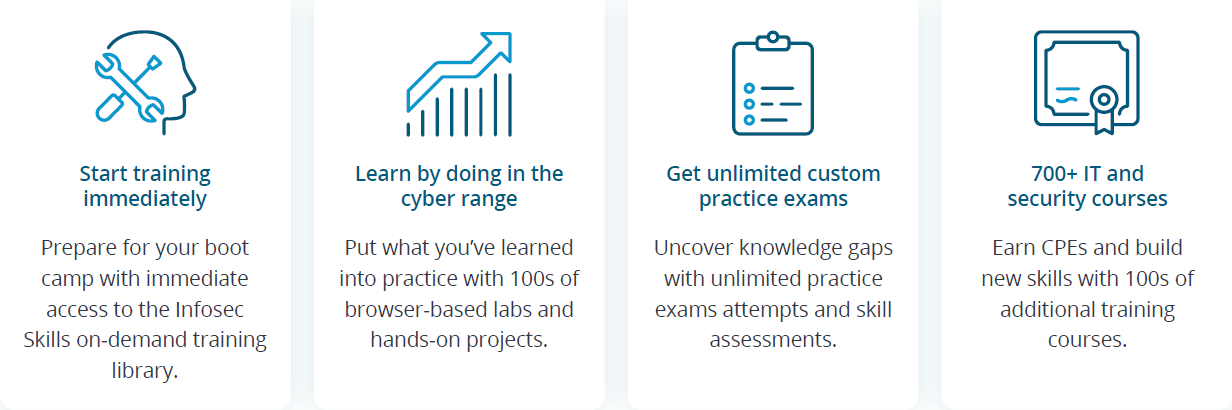
The hands-on cybersecurity training platform that moves as fast as you do

Boot camp at a glance

Who should attend

  • Chief information security officers
  • Security systems administrators
  • Information assurance analysts
  • IT security engineers
  • Senior IT security consultants
  • Senior information security risk officers
  • Anyone who manages or oversees security strategies

What is Included:

  • Six days of live, expert CISSP instruction
  • Exam Pass Guarantee
  • Exam voucher
  • Unlimited practice exam attempts
  • 100% Satisfaction Guarantee
  • 90-day extended access to all boot camp video replays and materials
  • Pre-study learning path
  • Knowledge Transfer Guarantee

Free CISSP concentration training

Go beyond your CISSP and stand out from your peers by earning for one of the three CISSP concentrations. All CISSP Boot Camps come with free access to additional on-demand courses, including training for:

  • Information Systems Security Architecture Professional (CISSP-ISSAP)
  • Information Systems Security Engineering Professional (CISSP-ISSEP)
  • Information Systems Security Management Professional (CISSP-ISSMP)

Experienced instructors

Instructors have at least 10 years of industry training experience and are professionals with active roles in the industry. Thousands of students have earned their CISSP with the help of our expert instructors and industry-leading courseware.

Industry-leading pass rates

We’ve built a reputation for getting at the heart of the CISSP exam and providing the absolute best environment for CISSP preparation. More than 93% of our students pass their certification exams on their first attempt — the highest rates in the industry.

Skill up and get certified, guaranteed

CISSP Objectives

The goal of the boot camp is to prepare you for the challenging CISSP exam by covering the objectives defined in the (ISC)² common body of knowledge (CBK). The eight CISSP domain areas include:

  • Security and risk management
  • Asset security
  • Security engineering
  • Communication and network security
  • Identity and access management
  • Security assessment and testing
  • Security operations
  • Software development security

Course Outline

Before your boot camp

Start learning now. You’ll get immediate access to all content, including an in-depth CISSP prep course, the moment you enroll. Prepare for your live boot camp, uncover your knowledge gaps and maximize your training experience.

During your boot camp

Day 1: Security and Risk Management

  • Confidentiality, integrity and availability
  • Security governance policies and their supporting counterparts
  • Compliance
  • Global information security
  • Legal and regulatory policies
  • Professional ethics
  • Business continuity
  • Personnel security
  • Risk management
  • Threat modeling
  • Acquisition security
  • Security awareness

Day 2: Asset Security

  • Classify information
  • Identify and document asset ownership
  • Asset privacy concerns
  • Asset retention policies
  • Data security controls
  • Handling requirements

Security Engineering

  • Secure engineering processes
  • Review security engineering models
  • Security architecture
  • Web-based vulnerabilities
  • Mobile vulnerabilities
  • Embedded device vulnerabilities
  • Cryptography components and their relationships
  • Site and facility design
  • Physical security

Day 3: Communication and Network Security

  • Network architecture
  • Network components
  • Communication channels
  • Handling network attack

Identity and Access Management

  • Physical and logical access
  • Authentication of people and devices
  • Identity as service (cloud identity)
  • Third-party identity
  • Authorization mechanisms
  • Access control attacks
  • Provisioning life cycle

Day 4: Security Assessment and Testing

  • Validate assessment
  • Security control
  • Management and operational controls
  • Analyze and report test outputs
  • Internal and third party audits
  • Security operations
  • Handling investigations
  • Investigation types
  • Logging and monitoring
  • Provisioning of resources

Security Operations

  • Resource protection
  • Incident management
  • Preventative measures
  • Patch and vulnerability management

Day 5: Security Operations (continued)

  • Change management
  • Disaster recovery
  • Business continuity
  • Manage physical security
  • Personnel safety concerns

Software Development Security

  • Software development life cycle
  • Security for development environments
  • Software security
  • Purchased software risk

Day 6: Review of All Eight Domains

  • Practice exam

Day 7: Take CISSP exam

After your boot camp

Your access extends 90 days past your boot camp, so you can take additional time to prepare for your exam, get a head start on your next certification goal or start earning CPEs.

Prerequisites

In order to obtain the CISSP certification, you must have:

  • At least five years of professional experience in the information security field
  • A work history reflecting direct experience in at least two of the eight domains listed in the (ISC)² CISSP Common Body of Knowledge (CBK)

However, you can become an Associate of (ISC)² by passing the exam without the required work experience.

Similar courses

This course was built to incorporate a unique, in-depth, and interactive hands-on environment and systematic process across each ethical hacking domain and methodology, giving you the opportunity to work towards proving the required knowledge and skills needed to achieve the CEH credential.

More Information

The CCISO program is a first-of-its-kind training and certification course that aims to produce cybersecurity executives of the highest caliber and ethics.

More Information

This course introduces tools and tactics to manage cybersecurity risks, identify various types of common threats, evaluate the organization's security, collect and analyze cybersecurity intelligence, and handle incidents as they occur.

More Information

This course was designed for people who work in a Security Operations job role and helps learners prepare for the exam SC-200: Microsoft Security Operations Analyst.

More Information

Certified Information Security Manager (CISM) Boot Camp is a five-day training focused on preparing you for the ISACA CISM exam. You will leave with the knowledge and domain expertise needed to pass the CISM exam the first time you take it.

More Information

Certified Information Systems Auditor (CISA) Boot Camp is a five-day training focused on preparing you for the ISACA CISA exam. You’ll leave with the knowledge and domain expertise needed to pass the CISA exam the first time you take it.

More Information

CompTIA Security+ is a global certification that validates the foundational cybersecurity skills necessary to perform core security functions and pursue an IT security career. It establishes the core knowledge required of any cybersecurity role and provides a springboard to intermediate-level cybersecurity jobs. CompTIA Security+ is compliant with ISO 17024 standards and approved by the U.S. DoD to meet Directive 8140.03M requirements.

More Information

Gain a broad view of how to respond to a cybersecurity incident while preparing for the CyberSec First Responder certification.

More Information

Our Exam Cram sessions are intensive, focused review sessions designed to help your team master key concepts and pass their CompTIA certification exams with confidence. Led by expert instructors, these sessions provide in-depth, targeted hands-on practice to ensure your team is fully prepared for exam day. Security+ covers the most in-demand skills related to current threats, automation, zero trust, IoT, risk – and more. This exam cram session is included with the Security+ course.

More Information

The Certified Information Systems Security Manager (C-ISSM) course covers the skills and knowledge to assess threat analysis & risks, risk & incident management, security programs & CISO roles, IS security strategy & frameworks, audit & risk management creation of policies, compliance & awareness, as well as DR & BCP development, deployment & maintenance. This course not only covers ISACA®'s CISM exam, but will provide a measurable certification that demonstrates proficiency in the IS Management field.

More Information

This scenario-based course focuses on computer security as an applied process across job roles and industries. The course also helps to prepare students for achieving the widely regarded Certified Information Systems Security Professional (CISSP) certification.

More Information

This course provides IT Security Professionals with the knowledge and skills needed to implement security controls, maintain an organization’s security posture, and identify and remediate security vulnerabilities. This course includes security for identity and access, platform protection, data and applications, and security operations.

More Information

The Microsoft Identity and Access Administrator course explores how to design, implement, and operate an organization’s identity and access management systems by using Microsoft Entra ID (Formerly Azure AD). Learn to manage tasks such as providing secure authentication and authorization access to enterprise applications. You will also learn to provide seamless experiences and self-service management capabilities for all users.

More Information

Learn how to protect information in your Microsoft 365 deployment. This course focuses on data governance and information protection within your organization. The course covers implementation of data loss prevention policies, sensitive information types, sensitivity labels, data retention policies and Office 365 message encryption among other related topics. The course helps learners prepare for the Microsoft Information Protection Administrator exam (SC-400).

More Information

The Cloud is being widely adopted today for a diverse set of reasons. However, many are finding that security in the cloud is a huge challenge. The C)CSO looks to fill the gap in cloud security education and give you the skills you need to develop strong cloud security.

More Information

The Certified Security Principles (C)SP) course is going to prepare you for security across the entire environment including understanding risk management, identity and access control, network and data security. This is just a short list of everything covered within this course, which will include new technologies like IoT and cloud services. This course is intended to prepare you to become a benefit to any company attempting to improve its security posture.

More Information

The Certified Cybersecurity Systems Auditor (C)CSSA) course covers the skills and knowledge to assess vulnerabilities, report on compliance and implement controls for private and public enterprises. Many organizations require a Cybersecurity System Auditor's expert knowledge when it comes to identifying critical issues and providing effective auditing solutions.

More Information

The CISSO addresses the broad range of industry best practices, knowledge and skills expected of a security manager/officer. You will learn in-depth theory pertaining to the practical implementation of core security concepts, practices, monitoring and compliance of IS management. Whether you’re responsible for the management of a Cybersecurity team, a Security Officer, an IT auditor or a Business Analyst, the C)ISSO certification course is an ideal way to increase your knowledge, expertise and skill.

More Information

To protect an information system you need to be able to see that system through the eyes of the attacker. The Certified Professional Ethical Hacker certification course is the foundational training to a line of penetration testing courses because it teaches you to think like a hacker. Therefore, you can set up dynamic defenses to prevent intrusion.

More Information

A Certified Penetration Testing Engineer (C)PTE) imagines all of the ways that a hacker can penetrate a data system. In this course you will learn 5 Key Elements of Pen Testing, discover the latest vulnerabilities and the techniques malicious hackers are using to acquire and destroy data and learn more about the business skills needed to identify protection opportunities, justify testing activities and optimize security controls appropriate to the business needs in order to reduce business risk.

More Information

The Certified Secure Web Application Engineer (C)SWAE) course is delivered by high level OWASP experts and students can expect to obtain real world security knowledge that enables them to recognize vulnerabilities, exploit system weaknesses and help safeguard against application threats. You will learn how to develop web applications that aren't subject to common vulnerabilities, and how to test and validate that their applications are secure, reliable and resistant to attack.

More Information